
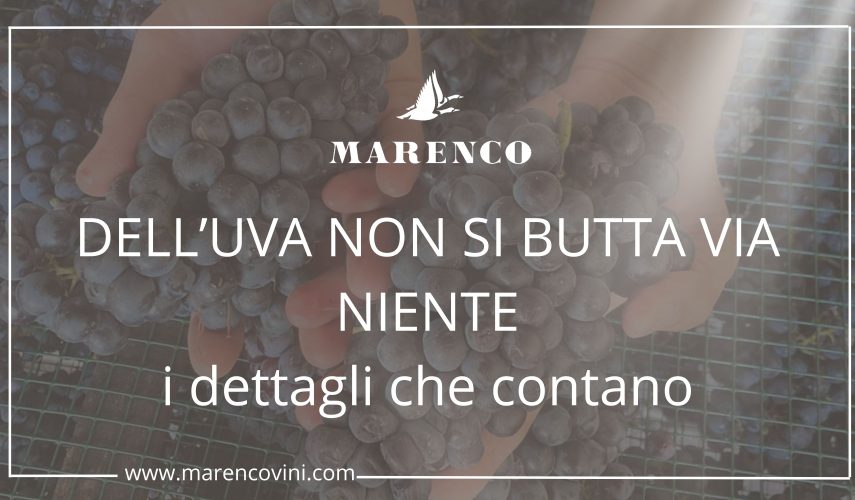
Quando guardiamo l’uva il primo pensiero che ci sfiora è proprio quello del vino!
Ma l’uva in realtà non è così scontata e tantomeno la sua trasformazione.
Per millenni, e in luoghi diversi del mondo, il vino è stato prodotto, consumato e conservato in modi e recipienti diversi.
Gli antichi romani, ad esempio, usavano conservarlo in anfore di terracotta; lo allungavano spesso con dell’acqua e lo aromatizzavano con spezie e/o miele.
Noi siamo abituati oggi a vederlo così, sottoforma di bottiglia da 0.75 l.
Questo perché la resa media per un chilogrammo di uva è proprio 0.75 l di mosto (naturalmente dipende da molteplici fattori, dal tipo ti vitigno all’annata).
Esiste anche una magica coincidenza: la capacità polmonare dei soffiatori di bottiglie del ‘700 era proprio di 0.75 l.
Coincidenza o magia, oggi 0.75 l è il formato standard della bottiglia di vino.
E il resto che fine fa? Beh, dell’uva non si butta via proprio niente!
Il raspo, che non viene più tenuto in macerazione come una volta, può essere sapientemente impiegato come concime organico.
Le vinacce vengono conferite in distilleria per la produzione di grappa di qualità. E la vinaccia stessa, una volta esausta, può diventare concime o combustibile organico.
Persino i semi trovano il loro posto in questo ciclo, donando il pregiato olio di vinacciolo, ricco di antiossidanti e polifenoli (proprio come l’uva!) e con proprietà emollienti e nutrienti.
Il ciclo rinnovabile dell’uva segna il ritmo annuale della viticultura, che Marenco segue ormai da più di 100 anni.
———————————————————————————————————————————————————————-
When we look at grapes, the very first thought that comes to mind is wine!
But grapes are not as simple as they may seem, nor is their transformation.
For thousands of years, and in different parts of the world, wine has been produced, consumed, and stored in many different ways and containers.
The ancient Romans, for example, used to store it in terracotta amphorae; they often diluted it with water and flavored it with spices and/or honey.
Today, we are used to seeing it like this: in a 0.75-liter bottle.
This is because the average yield from one kilogram of grapes is about 0.75 liters of must (of course, this depends on many factors, from the grape variety to the vintage).
There is also a curious coincidence: the lung capacity of 18th century glassblowers was about 0.75 liters.
Coincidence or magic, today 0.75 liters is the standard size of a wine bottle.
And what happens to the rest? Well, nothing from the grape goes to waste!
The stems, which are no longer left to macerate as they once were, can be skillfully used as organic fertilizer.
The pomace is sent to distilleries for the production of high-quality grappa. And once exhausted, it can still be used as fertilizer or organic fuel.
Even the seeds find their place in this cycle, yielding valuable grapeseed oil, rich in antioxidants and polyphenols (just like grapes!) and known for its emollient and nourishing properties.
The renewable cycle of the grape sets the annual rhythm of viticulture, one that Marenco has followed for more than 100 years.
